Alpha Portfolio Service Brochure
A car-tastrophe
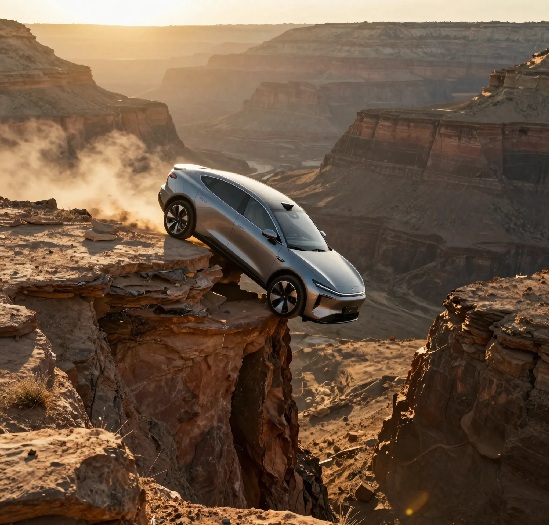
You can always rely on politicians to throw a spanner in the works.
Trump’s radical reversal of America’s climate policy has forced car manufacturers to make a U-turn away from EVs (electric vehicles). The cancellation of EV credits in the US and Trump’s determination to further roll back regulations to cut vehicle emissions have led carmakers to lower EV sales expectations to just 5% of new US car sales – about half the current level.
At the same time, Western companies are facing increased competition from Chinese rivals such as BYD. China’s BYD moved ahead of Tesla last year in sales of EVs. However, BYD is now having to check in the rear-view mirror at a lesser-known domestic rival, Leapmotor, which is producing no-frills, low-cost EVs that are proving a hit with Chinese consumers. Ominously, Leapmotor is following BYD’s lead and is now turning to international markets with ambitions to sell 4 million cars globally. Last year it produced 600,000 cars, double that of 2024, which was four times higher than in 2023.
The reversal in EV ambitions is estimated to have resulted in a hit of at least $65bn for the western car industry last year alone. Stellantis, the owner of Peugeot and Fiat recently took a $26bn charge to scrap some EV models. Ford took a $19.5bn write-down as it cancelled its electric F-150 pickup truck while General Motors has taken a $6.7bn hit. Meanwhile, Honda has warned it is reassessing its EV strategy and has ended its EV partnership with General Motors in the US. Even EV star Tesla has suffered a significant fall in sales due to competition from China but possibly also due to a backlash against Elon Musk’s politics.
The shortcoming of Western carmakers has possibly been their failure to offer EVs that meet drivers’ price and range expectations, while investment in charging infrastructure has also been lacking. Some will no doubt be alarmed by Leapmotor’s no-frill EV offering. Stellantis has entered into partnership with Leapmotor in Europe. Will this prove to be a complementary EV offering within the Stellantis range, or could it lead to cannibalisation with customers potentially switching their cars to the Chinese brand?
The structural see-saw underway in the global car industry should be alarming for politicians, as it remains a very important part of the manufacturing sector and a substantial employer in many economies.
What have we been watching?
The US Supreme Court threw a spanner in Trump’s tariff strategy which, once again, leaves markets facing major uncertainties! Meanwhile, markets moved on from AI worries to fears about events in the Middle East. Despite this uncertainty, the equal-weighted S&P 500 index (which adjusts for the US mega-tech companies) hit a record high, as did European equities including the FTSE 100.
The US Supreme Court ruled, by a 6-3 margin, that Trump’s use of IEEPA tariffs was unconstitutional. In the immediate aftermath, Trump had said he would pursue a 10% global tariff under Section 122 authority but over the weekend this increased to 15%. However, under Section 122 these tariffs can only remain in place for 150 days, so until the end of July, after which congressional approval would be required to extend them. The problem is that this would be just over three months before the US midterm elections and if a handful of Republicans in either chamber were reluctant to support these tariffs, which are in effect a consumer tax, then they would lapse. Would Trump then look to similar legal authorities such as Section 232 (national security) or Section 301 (unfair trade practices) to re-establish more durable tariffs? However, these would probably be narrower in scope and subject to legal challenge. In summary, nobody can really make sense of what is happening right now with growing uncertainty for America’s trading partners and how this will pan out, although it does feel as if the overall effective tariff rate will come down in 2026. Ironically, Brazil and China will be the big winners from Trump’s new 15% tariffs, while other countries he has in the past singled out for running huge surpluses with the US, such as Vietnam, Thailand and Malaysia, will also be better off. By comparison, American allies such as the UK, EU and Japan will be worse off.
American military resources continue to build in the Middle East ahead of talks later this week between the US and Iran in Geneva. Trump is questioning why Iran has not yet ‘capitulated’ in the face of America’s military buildup according to US special envoy Steve Witkoff. American media suggest Trump is considering an initial targeted strike against Iran in the coming days, which could be followed by a larger attack if Iran does not give in to America’s nuclear demands.

In the UK, there was some good news for Chancellor Rachel Reeves as January tax receipts created a £30.4bn surplus. Meanwhile, UK unemployment climbed to 5.2% while youth unemployment reached 16.1%. However, the softness in the UK jobs market increased market hopes for further interest rate cuts by the Bank of England. The chances of a 0.25% interest rate cut in March increased to 79%.

European markets were propelled to record highs by better than expected ‘flash’ PMI business activity data. The euro area composite PMI improved to 51.9 following three consecutive months of decline. Within the data, activity in Germany improved to 53.1 reflecting the fiscal stimulus package.

In the US, economic growth in the fourth quarter of 2025 was weaker than expected at 1.4%. Core PCE inflation was higher than expected in December. This has brought the annual rate of core PCE – the Federal Reserve’s (Fed) preferred measure of inflation – back up above 3% for the first time in ten months. As a result of this and concerns about America’s fiscal outlook given the US Supreme Court ruling on IEEPA tariffs, markets dialled back expectations for further interest rate cuts by the Fed in 2026.

Brent oil climbed above $71 as traders continued to study the US military build-up in the Middle East ahead of talks with Iran.
Finally, trouble brewing? Scottish craft beer company Brewdog, which was founded in 2007 has appointed AlixPartners to ‘support a structured and competitive process to evaluate the next phase of investment for the business.’ Last year, Brewdog lost £37m as it undertook a number of restructuring measures. Yet another sign, if one was needed, of just how tough it has been for the pub trade. Not good news either for those investors who participated in Brewdog’s earlier ‘Equity for Punks’ scheme. As Clint Eastwood, (Dirty Harry) said, ‘Do you feel lucky, Punk?’

1 The Square,
Temple Quay,
Bristol BS1 6DG
Tel: 0117 203 3460
Email: info @ alpha-pm.co.uk

Full version
© Alpha Portfolio Management 2026. All Rights Reserved
Site by Lookhappy