Alpha Portfolio Service Brochure
Leaning to the left
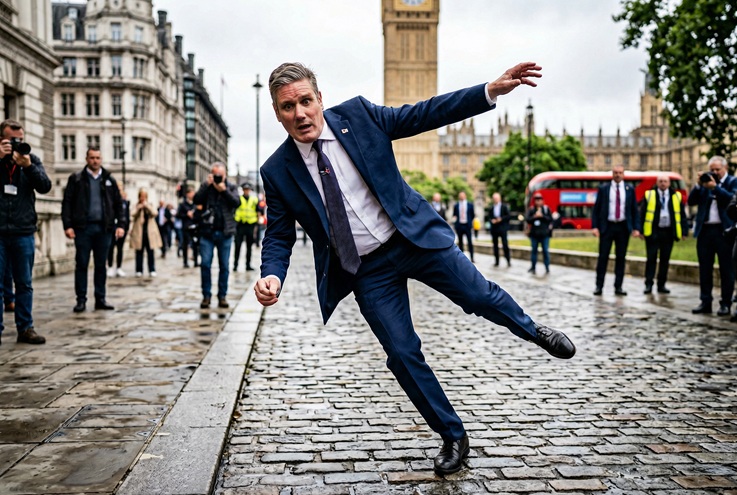
Are the knives out for PM Sir Keir Starmer?
On a weekend of heightened global geopolitical tensions, closer to home, political risk is on the rise.
Whilst domestic politics has been somewhat overshadowed by events in the Gulf, PM Sir Keir Starmer has recently been forced into making yet another embarrassing U-turn, this time on the delay to local council elections in May. The government was forced to cave in ahead of an imminent legal challenge from Reform UK.
Last week Labour lost the ‘safe seat’ of Gorton and Denton in a by-election. The decision by the Labour Party NEC to block Andy Burnham standing and the renewed scandal surrounding Peter Mandelson following a further release of Epstein files appear to have fatally weakened Starmer’s standing with MPs, the broader Labour Party and ultimately voters. When confidence is lost, it is hard to get it back and he may not survive the loss in the Gorton and Denton by-election followed by a poor showing in the May local elections.
Betting markets now price in over a 70% chance that he does not survive 2026 as PM!
If the party loses faith in Starmer, markets will have to consider the alternative candidates, including Wes Streeting, Angela Rayner, Andy Burnham and Ed Miliband, the majority of whom are more left-leaning. This might be a worse outcome for the UK economy and stock market. However, a new PM would find their room for manoeuvre constrained by having to stick largely to the manifesto that the party was elected on and, more importantly, by the steadying hand of the bond market.
While there is nothing to stop a new Labour PM coming back for more tax rises, this would not sit well with the UK electorate.
So, recent tax increases together with the constraints of the bond market may prevent a ‘worse case’ scenario for investors from a shift to the left. However, if there were to be a protracted leadership contest, then it would likely weigh on consumer, business and domestic market sentiment in the short term. Markets hate uncertainty, but politicians should have learnt lessons from PM Liz Truss and that ultimately bond markets tend to emerge as the winner.
Meanwhile, is the Gorton and Denton by-election also the nail in the coffin of Britain’s traditional two-party political system?
What have we been watching?
2026 is only two months old, yet more mayhem as markets have to contend with the latest crisis in the Middle East.
Markets generally had a strong February, and the FTSE 100 hit a record high, as did Japan ‘s NIKKEI index, although US equities edged lower on AI worries, concerns about the US regional banking system and the US Supreme Court striking down Trump’s IEEPA tariffs. Things have now been thrown up in the air by the US and Israeli airstrikes on Iran over the weekend and the killing of Iran’s Supreme Leader Ali Khamenei. Reflecting the uncertainty, gold hit a record high, government bond yields initially moved lower, while defence contractors and oil producers rose in value.

Trump has said that the US could keep up its campaign against Iran for ‘four to five weeks’ but said he is open to lifting sanctions against the country if its new leadership were pragmatic. However, the current message from Iran is that it will not negotiate with the US. Meanwhile, with US military fatalities, how will this sit with US voters ahead of the mid-term elections? What message will this also send to Putin over Ukraine and China regarding Taiwan? The world remains a dangerous place!

Oil prices have leapt this morning with Brent oil up 10% to $80. The Strait of Hormuz has been effectively closed by Iranian strikes on oil tankers. About 20% of the world’s oil supplies are shipped through the Strait of Hormuz and with shipping piling up on either side, traders have been scrambling for supplies of crude oil. OPEC+ has agreed to boost output by 206,000 barrels of oil a day, but the majority of this still needs to be shipped through the Gulf.
Of equal concern to markets is the disruption to LNG supplies. A halt in gas supplies through the Strait of Hormuz could be comparable in scale to the curtailment of Russian gas supplies to Europe. Both Asia and Europe are the main consumers of LNG. Airlines and energy-intensive industries have seen large share price falls this morning. Markets have no clear view yet of how long and how successful the US and Israeli air campaign against Iran will be and whether it will succeed in achieving regime change. How effective will it be in destroying Iran’s nuclear, ballistic missile and drone manufacturing capacity? Tourism-related sectors have also seen share price falls this morning as Iran continues to target neighbouring countries in the Gulf.
While the world is not as exposed to oil prices as in the 1970s, it is more dependent on LNG. Central banks will be wary of the impact of higher energy prices for the global inflation outlook should the Middle East conflict prove to be prolonged. UK and European gas prices have leapt over 24% this morning. Readers may recall that Ofgem lowered its April price cap by 7% for April following a mild winter, so how will events in the Middle East impact household energy bills beyond this?
Looking back at last week, which now feels like a long time ago, the main investment theme continued to be AI disruption. AI continues to overshadow markets, albeit this has been overtaken by events in the Middle East. Nonetheless, it remains a concern stoking irrational thinking in the US. For example, this was reflected in the now infamous memo from Citrini Research, which outlined a hypothetical scenario in which AI adoption drove the US unemployment rate into double digits by mid-2028! Meanwhile, AI chip giant Nvidia delivered quarterly earnings that once again failed to deliver the positive surprise that US investors have become accustomed to dragging down the Mag 7 and NASDAQ index.
Finally, talking of politics, UK youth unemployment recently rose above 16%. Almost 1 million youngsters aged between 16 and 24 are either not in education, employment or training. A very sad statistic and not great for the UK economy. It’s also a hot potato for politicians!

1 The Square,
Temple Quay,
Bristol BS1 6DG
Tel: 0117 203 3460
Email: info @ alpha-pm.co.uk

Full version
© Alpha Portfolio Management 2026. All Rights Reserved
Site by Lookhappy