Alpha Portfolio Service Brochure
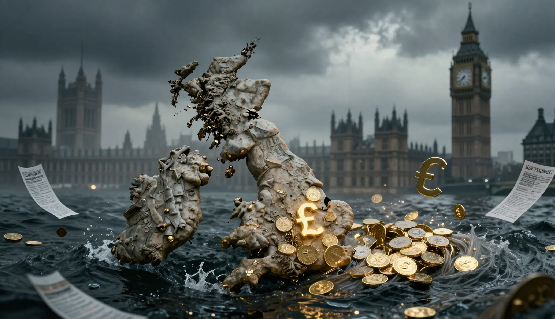
Britain’s Debt Crisis
The European debt crisis beginning in 2009 saw a series of government debt and financial crises in the Eurozone triggered by high government borrowing, banking vulnerabilities and a global financial downturn. This particularly affected Portugal, Ireland, Italy, Greece and Spain, or the ‘PIIGS’, as they became known.
Fast forward to today and the energy shock and economic uncertainty from Trump’s Gulf War have pushed up government borrowing costs, but markets are no longer concerned by the ‘PIIGS’ but instead by Britain, Italy and France, collectively known as the ‘BIFs’. All three have ageing populations, growing welfare costs and stretched government finances. This coincides with pressure from both Trump and Putin for NATO to increase defence spending, which is putting additional pressure on government spending commitments.
The UK currently offers a gross redemption yield or interest rate of 4.8% on its benchmark 10-year Gilt, the highest of any in the G7. Britain has also suffered the biggest increase in borrowing costs since the Gulf started of any major economy.
The cost of government borrowing globally has risen and markets have become more concerned about those countries where debt to GDP (Gross Domestic Product) ratios are already stretched. The UK’s debt challenge was underscored last week by a record £15bn syndicated 2036 Treasury Gilt launch by the Debt Management Office that carried a 4.91% redemption yield. That is the highest yield offered in any 10-year UK government bond fundraise since 2008!
Despite Chancellor Rachel Reeves’ much vaunted ‘fiscal headroom’ following a record tax burden on British businesses, the reality is that much now rests on UK economic growth. Despite North Sea oil and gas and the growth of renewables, the UK is still reliant on imported energy. Trump’s Gulf War has driven up energy prices, which will adversely impact UK economic growth. A great deal hangs on the duration of the conflict in the Gulf and whether the Strait of Hormuz re-opens to shipping.
It doesn’t take a financial genius to realise that higher government borrowing costs are painful. Britons are already enduring a record tax burden, but the Labour government doesn’t seem willing to address the ballooning welfare bill. So, just how can the Chancellor improve the UK’s finances and improve the UK’s appeal to global bond investors? Political uncertainty is not helpful either, with PM Sir Keir Starmer facing an uncertain future due to the Peter Mandelson vetting row.
What have we been watching?
The Strait opened, then closed……
Hopes of a de-escalation between the US and Iran helped propel markets higher last week, with the US S&P 500 index closing at a record high. The scale of the relief bounce in US equities has been staggering – just 11 days ago the S&P 500 was trading at an eight-month low! European and Asian equities – particularly Japanese equities – also put in a strong performance last week. Hopes of a peace deal and the freeing up of the Strait of Hormuz eased market fears of a global energy shock and stagflation.
Markets were very firm on Friday and oil prices fell after the Iranian leadership announced they were reopening the Strait of Hormuz after the Lebanon ceasefire and Trump suggested that Iran was surrendering all its nuclear material. Trump said, ‘It’s looking very good and we’re going to make a deal with Iran, and it’s going to be a good deal.’ He claimed that Iran ‘had agreed to almost everything’, including handing over the ‘nuclear dust.’
However, both these claims have turned out not to be correct over the weekend, and the Strait of Hormuz seems very much closed, with both Iran and the US firing on commercial shipping.
There is speculation that Pakistan will host another round of peace talks on Tuesday as the current ceasefire is due to end at some point on Wednesday. Trump was more hawkish over the weekend and once again threatened to ‘knock out every single power plant and every single bridge in Iran.’ Meanwhile, Iran reported that it has ‘no plans for now to participate’ in talks after US marines seized an Iranian ship that tried to run the American naval blockade. While the US may have the military might, for now Iran continues to hold the world to ransom by blocking shipping through the Strait of Hormuz and appears to be calling Trump’s bluff. Keep watching Trump’s approval rating with US voters, as a renewed deterioration in negotiations would be unlikely to help his chances in the US mid-term elections if US gasoline prices were to rise again.
The IMF published its latest World Economic Outlook and downgraded its global economic growth forecasts and upgraded inflation. Global growth is now expected to be 3.1% with the growth outlook cut for those countries directly affected by Trump’s Gulf War, particularly those that import large amounts of energy. The IMF has raised its global inflation forecast to 4.4%.
While all eyes are upon the Gulf and Trump continues to lash out at anyone who criticises his Gulf War, there was some further Trump tariff news. US Treasury Secretary Scott Bessent said that the tariffs that had been struck down by the US Supreme Court could be restored to previous levels by mid-summer. He said, ‘We will be implementing or conducting Section 301 studies, so the tariffs could be back in place at the previous level by the beginning of July.’ This comes as Chancellor Rachel Reeves told Americans that Trump’s Iran war was a mistake. In turn, this led Trump to threaten that he would shred the current US-UK trade deal!

The UK economy saw its biggest monthly rise in February in more than two years, with GDP growing by 0.5%. Unfortunately, this is not set to continue due to Trump’s Gulf War, which has created massive uncertainty.

European Central Bank (ECB) president Christine Lagarde said that the central bank ‘did not have a tightening bias.’ This helped ease investor concerns about an immediate ECB interest rate hike in April.

In the US, while equities have been propelled higher by hopes of peace talks, the latest inflation data has also been supportive. The headline Producer Price Index (PPI) inflation reading was slightly softer than expected in March, rising by 0.5% for an annualised 4%. The week ahead is also a key one for markets as Kevin Warsh, Trump’s nominee to become the next chair of the Federal Reserve, is due to appear before the Senate Banking Committee. He has previously argued for lower US interest rates due to disinflationary forces such as deregulation and AI.

China’s economy grew faster than expected in the first quarter of 2026, with GDP growing by 5%. This was despite the Gulf War starting to impact the economy in March. The outperformance was driven by exports, particularly EVs. However, exports are likely to weaken given the Gulf War impact on many western economies. Presidents Trump and Xi Jinping are expected to meet in May when tariffs will no doubt be discussed and Trump must be hoping a peace deal with Iran can be concluded ahead of such a meeting. While berating NATO allies, Trump has so far been strangely quiet about news that Iran deployed a Chinese satellite to target US military bases across the Middle East!

Brent oil eased back from $101 to just over $91 last week on news that Iran was to re-open the Strait of Hormuz. However, developments over the weekend have once again taken a turn for the worse and this morning Brent oil is up 4% to about $95.
Finally, with the Gulf War dominating headlines, investors should not forget the ongoing AI uncertainty which has overshadowed many traditional business models in recent months. In the latest twist last week, the launch of Anthropic’s Claude Mythos AI tool, which has advanced cyber-security capabilities, has been delayed after fears were raised that it could cause a wave of catastrophic attacks that could take down critical infrastructure if it were to fall into the wrong hands. Let’s hope that is not Iran!

1 The Square,
Temple Quay,
Bristol BS1 6DG
Tel: 0117 203 3460
Email: info @ alpha-pm.co.uk

Full version
© Alpha Portfolio Management 2026. All Rights Reserved
Site by Lookhappy