Alpha Portfolio Service Brochure
Russia’s Fuel Crisis
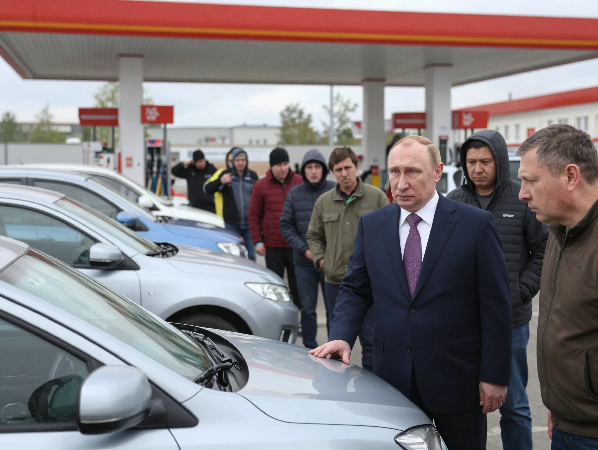
Events in the Gulf have tended to overshadow the ongoing war of attrition in Ukraine. However, the conflict, now in its fourth year is being felt closer to home for many across Russia.
It is harder for the authorities to ignore the increasing number of Ukrainian drone and missile strikes deep into Russian territory, targeting oil refineries, darkening the skies over Moscow and St Petersburg. Russia, one of the world’s biggest oil producers, is struggling to refine enough fuel to meet domestic demand, leading to big queues at petrol stations.
Ukraine claims to have disabled 43% of Russia’s oil refining capacity. A significant number of Russian regions are experiencing fuel restrictions. It is thought to be affecting 50 million people – c. 35% of the population. This is leading to growing public discontent.
Ukraine has already attacked Russia’s ten largest refineries, but now Ukrainian drones have struck Russia’s biggest oil refinery in Omsk, which is 2,500km from the border. It has also attacked Russia’s shadow fleet, forcing Putin to suspend shipping in the Sea of Azov.
Putin has responded by attacking civilian targets in Ukraine, as its American supplied air defence capability is running low. America is believed to have used half of its Patriot interceptor missiles in Iran and is reluctant to supply more. However, Trump has offered to give Ukraine the right to produce Patriot interceptor missiles under licence to help defend Kyiv, but how easy this will be to do remains to be seen. At least it marks a shift by Trump away from Putin and towards Zelensky.
Tump continues to vent his frustration at his European NATO allies, many of whom, including the UK, are not ramping up defence spending as fast as he would like. At the recent NATO leaders’ conference, he warned that the US ‘could remove all our soldiers from Europe.’ He also continues to hope for a possible meeting between Putin and Zelensky to end the war in Ukraine. With so little trust between Ukraine and Russia, a lasting peace deal still looks like a long stretch.
Meanwhile, Trump continues to struggle to bring Iran to heel and is facing further US armed personnel fatalities. The escalation in the Gulf once again elevates the risks of global stagflation and nobody wants that!
What have we been watching?
The escalating conflict in the Gulf which has reignited fears about global stagflation together with fresh concerns around the US AI trade given the competitive threat from Chinese AI business models. The Philadelphia Semiconductor Index fell by almost 10% last week, marking the biggest weekly decline since Trump’s Liberation Day tariff announcement last year.
The conflict in the Gulf has intensified markedly over the weekend as the series of tit-for-tat attacks between the US and Iran continued. Three US service personnel were killed in separate Iranian missile attacks in Jordan and Iraq, while US strikes hit targets in multiple locations, including Iran’s main oil export facility on Qeshm Island. At the same time, Iran has broadened its retaliatory attacks beyond military sites, targeting critical infrastructure across the Gulf, including power and desalination facilities in Kuwait. More alarmingly, tensions have also escalated in the Strait of Hormuz, with Iran signalling a more assertive stance over shipping flows and claiming to have intercepted or attacked shipping attempting to transit the waterway. Prospects for any diplomatic breakthrough remain dim with Iran’s foreign minister suggesting that some nuclear issues ‘remain unresolvable.’ Iran has also asked Yemen’s Houthis to stand ready to close the Red Sea to oil shipments if the US hits Iranian power facilities.
Following 9 days of US attacks on Iran and retaliatory strikes, Brent oil saw its largest weekly increase since April, rising by over 15%. This morning, following the further escalation over the weekend, Brent oil has climbed a further 3% to over $90. European gas prices have also started to rise again as concerns grow about gas production facilities in the Gulf region.

In the UK, Andy Burnham takes office as Prime Minister today, with ministers to be appointed and policy plans starting to take shape. Markets are expecting the government to move further to the left, so the question is how far? The new PM is expected to take a more pragmatic approach to North Sea oil and gas given events in the Gulf. Meanwhile, the UK economy was a touch firmer than expected in May as GDP ticked up 0.1%, helped by a bounce in activity in the service sector.

In the US, softer than expected inflation data, with the CPI increasing by 3.5% in June, saw markets dial back the prospect of an imminent interest rate hike by the Federal Reserve.

China’s economy grew by 4.3% in the second quarter, which was down from the 5% growth seen in Q1. Domestic demand remains a major area of concern for the authorities, albeit exports remain strong, helped as China continues to flood markets with cheap EVs.
Finally, Elon Musk’s SpaceX recently became the largest ever initial public offering and its shares shot up from $135 to an intraday high of $225 in a very short time. Many US investors saw SpaceX as an AI play, as earlier this year it acquired Musk’s start-up xAI, best known for the chatbot Grok. However, its main business is the manufacture and launch of rockets and communications satellites called Starlink. At the beginning of this month, Starlink announced it was cutting the price of its services in Memphis, Tennessee, amid local concerns over a massive data centre project. This, together with volatility in AI stocks, has seen SpaceX shares fall by 45% from their peak. SpaceX currently operates at a loss on $18bn of revenue, but Musk is targeting $1trillion of revenue by 2030 – a fifty plus fold increase. Now that is shooting for the stars!

1 The Square,
Temple Quay,
Bristol BS1 6DG
Tel: 0117 203 3460
Email: info @ alpha-pm.co.uk

Full version
© Alpha Portfolio Management 2026. All Rights Reserved
Site by Lookhappy