Alpha Portfolio Service Brochure
The Thames Barrier to the North-South divide
The track record of successive UK governments when it comes to delivering massive infrastructure projects on time and within budget is not great, with HS2 being a prime example. HS2 is even more disappointing in that it looks as if it will fail to deliver anywhere near the original ambitions to connect the North of England with London.
New PM Andy Burnham is seeking to redress the North-South imbalance by devolving more power to the regions, with some reports of up to 90,000 jobs eventually moving from London to the North. However, could the Thames Barrier throw a spanner in the works given government finances?
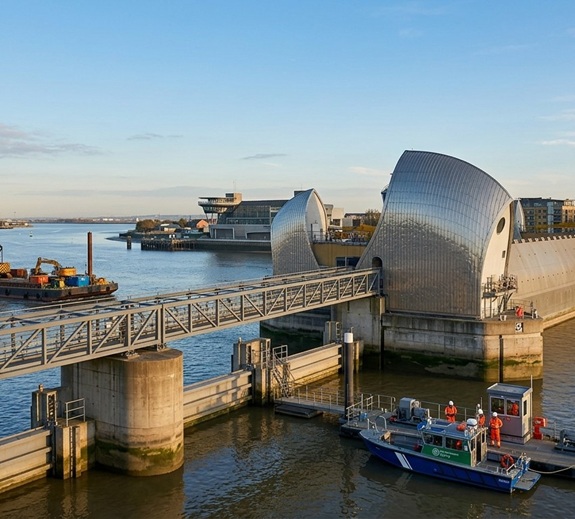
The Thames Barrier, which protects London from flooding, may need to be replaced up to two decades earlier than planned and could cost in excess of £20bn!
When it was built in the 1980s, it was expected to last until 2030, but subsequently, it has been hoped that it might offer protection until 2070. However, due to climate change and rising sea levels, government officials now believe it may need to be replaced between 2050 and 2060. An increase in extreme weather has caused degradation to the infrastructure and prevented maintenance from being carried out.
It is thought that including planning, it could take up to 30 years to build a replacement Thames Barrier. Options for a replacement include building a new barrier with locks on the existing site at Woolwich Reach in east London to improve resilience or building a new barrier further downstream. These could also be supported by the creation of flood storage areas such as reservoirs and marshlands to store excess water.
London’s importance as a global financial centre cannot be ignored, neither can over £300bn of residential property or key infrastructure such as the London Underground, not forgetting the many sites of historical importance. Somebody is going to have to take a decision about the Thames Barrier in the not-too-distant future and it’s going to be a key one given the current North-South political and economic debate.
What have we been watching?
Government bond yields and the conflict in the Gulf continue to overshadow markets.
Over the weekend, there was a tit-for-tat escalation targeting commercial shipping around the Gulf. There were reports of several tanker incidents and maritime attacks which have, once again, heightened concerns about the security of energy supplies moving through the Strait of Hormuz. Both the US and Iran have accused each other of responsibility for the attacks! Brent oil, which increased by over 7% last week, has continued to climb this morning and has hit $97. Meanwhile, European natural gas futures recorded the fourth successive weekly gain, rising by over 7%.
Rising energy prices are leading investors to price in a growing probability of a greater inflationary shock, particularly in Europe, which, unlike the US, is not a major oil and gas producer. This has pushed government bond yields to multi-year highs around the world. For example, at one point last week, the German 10-year bond yield climbed to a post-2011 high of 3.37%, while the US 10-year Treasury yield briefly hit 4.78%. The UK was not immune from this trend, with the UK 10-year gilt yield hitting 5.29% before edging back slightly to 5.16%.

In the UK, the new Chancellor John Healey is set to give his view of the UK economy ahead of his budget on the 28th of October. It comes as Jaguar Land Rover announced 4,000 voluntary redundancies over the weekend. This should not come as a surprise, as we highlighted in last week’s Alpha Bites, Europe’s car industry is facing numerous challenges, particularly from Chinese imports. The new Chancellor’s tasks will be made more challenging by the rise in global bond yields.

In Europe, the main headline over the weekend is Germany’s political landscape shifting further to the right, after the AfD secured around 44% of the vote in the Saxony-Anhalt state election. It is the AfD’s strongest result in any German election to date and more than double its support from 2021. Chancellor Friedrich Merz’s CDU party slumped to 17% of the vote as voters expressed growing frustration over economic stagnation, energy costs and migration policy. The regional election result underlines how anti-establishment and populist parties continue to gain traction across Europe.

In the US, last week saw a very strong jobs report with payrolls up by over 162,000 in August, while there were upward revisions to the previous two months’ figures. This has increased the likelihood that the Federal Reserve (Fed) will increase US interest rates at its next meeting in September. Futures are currently pricing in a 62% chance of a Fed hike.
Finally, a topical example of inflation! The Thames Barrier took eight years to build and on completion in 1982, cost £535m. Any idea what that is in today’s money? Well, it’s £2.6bn! So even adjusting for inflation, the cost of the new Thames Barrier could be ten times that of the original.

1 The Square,
Temple Quay,
Bristol BS1 6DG
Tel: 0117 203 3460
Email: info @ alpha-pm.co.uk

Full version
© Alpha Portfolio Management 2026. All Rights Reserved
Site by Lookhappy