Alpha Portfolio Service Brochure
China’s Panda diplomacy
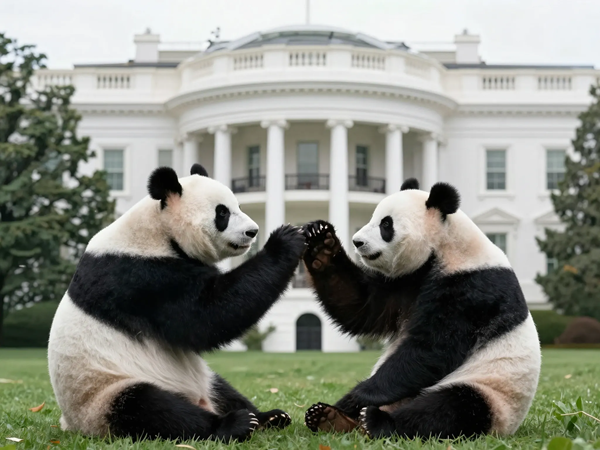
Xi Jinping received a red carpet welcome from Trump at their recent summit. This will have helped cement his image at home as Trump’s equal. In return, China has resumed its panda diplomacy by gifting two giant pandas – Ping Ping and Fu Shuang – to Atlanta’s zoo.
However, despite Trump rolling out the red carpet for him, Xi Jinping didn’t get everything he wanted. The trade truce has been extended, but only by two months until 10th January. This suggests that the US wants China to do more to fulfil its side of the bargain before pandering to China’s commercial and political ambitions. The large can, containing Trump tariffs, China’s dominance of rare earth minerals and access to advanced US AI chips, has been kicked down the road.
The two superpowers also remain at loggerheads over Taiwan. Xi Jinping once again made it clear that US arms sales to Taiwan are a red line for China. Trump had previously delayed a $14bn defence package for Taiwan but is coming under bipartisan pressure to continue US support for Taiwan.
Whilst AI and hardware manufacturing are booming, thanks to vast state-funded investment, the uncomfortable truth for Xi Jinping is that the domestic manufacturing economy is in trouble and AI creates relatively few jobs.
A heavily undervalued currency and many open or hidden subsidies are helping buy global market share, such as in EVs. Export markets are helping prop up growth. China’s high-tech factories are churning out cheap EVs, assembled by robots. However, outside the factory gates stands a young university graduate who cannot find a job. Youth unemployment remains stubbornly high and that university graduate is unlikely to have a baby. China’s birth rate has fallen to just one child per woman, a slow-motion demographic disaster. Meanwhile, property prices have slumped, which has further undermined consumer confidence. Domestic new car sales have fallen by 20% from a year ago. This is unhelpful for much of China’s manufacturing sector, which is suffering from overcapacity.
Is the US in better shape? Trump also has his problems with the midterm elections looming and Iran not altering its stance over the Strait of Hormuz. The US long-term issues are mostly on a lesser scale than China, but the country suffers from its own imbalances, and what about that massive investment in AI? However, as a market economy with a deep and open capital market, solid institutions and the rule of law, the much richer US maintains many advantages over China.
Perhaps Trump and Xi Jinping should be focusing on consumers at home, instead of grandstanding with pandas or on a red carpet?
What have we been watching?
A global government bond sell-off, European bond contagion on fears of stagflation and that some developed country governments are spending beyond their means. The situation was not helped by Trump, who had threatened to block US diesel exports. This fear eased slightly following the news that oil and diesel would be released from the G7 strategic reserve. Markets had been concerned that central banks would need to hike interest rates in October, but the European bond contagion and softer US jobs data appear to have removed some of the immediate pressure. US equities were relatively steady last week, but European equities, which are dominated by banks and financials, were impacted by the volatility in bond markets.
Brent oil rose by almost 5% last week as Houthi attacks on Saudi Arabian energy infrastructure continued, as have Iranian attacks on oil tankers in the Strait of Hormuz. Trump also threatened to block exports of US diesel, as he has come under pressure to help US consumers ahead of the midterm elections. However, there was some relief for refined products, as at the end of last week the G7 countries announced a plan to release 100 million barrels of oil and diesel from the strategic reserve. This morning Brent oil has eased slightly below $102.
The European bond contagion was triggered by concerns that some developed country governments are spending beyond their means. France is a particular concern, as government debt is 119% of GDP, the economy is not growing, and the deficit is 5.4% compared with an EU limit of 3%. This saw the spread between German and French 10-year government bonds widen to the greatest point since records began following German reunification in 1990! Other heavily indebted European countries saw the spread on their bonds widen against Germany, with Italy seeing it increase to a similar level as April 2020 during the initial wave of the Covid-19 pandemic. The UK was not immune from the turmoil in bond markets and at one point the yield on 30-year government debt climbed above 6%.

In the UK, new PM Andy Burnham gave a keynote speech at the Labour Party’s annual conference. He outlined such ambitions as a reform of social care, an increase in EU integration, an expansion of social housing and changing the voting system. He intends to stick to the Labour manifesto for now and cannot fully deliver on these ambitions until 2030, the next scheduled election. The idea appears to be to sell these policies to the public and then ask for a mandate. Burnham has pushed back against calls for an early election, saying the public want him to get on with the job, but the current manifesto stands in his way. Might we see an earlier UK general election in 2027 if Labour moves into a clear lead in the polls?

In Europe, the ‘flash’ CPI inflation came in ahead of expectations at 3.8%, putting more pressure on the ECB. However, higher French bond yields are already tightening financial conditions and should make it progressively harder for the ECB to deliver the interest rate hikes the market has been expecting. The French economy and ECB interest rate cycle appear inextricably linked at the moment. The chances of an ECB rate hike in October have fallen from 42% at the start of last week to 14%.

In the US, the jobs report for September was softer than expected, which led investors to dial back on expectations for an interest rate hike by the Federal Reserve (Fed) in October. The chances of this have fallen from 64% at the start of last week to 23% according to futures markets. Nonetheless, the US was not immune from the global bond sell-off, with the US 10-year Treasury yield hitting 5.27%. Besides government spending and debt issuance, US fixed interest investors also have had to take account of AI capital spending and associated bond issuance by US tech companies.
Finally, the RAC recently highlighted that the price of diesel had entered ‘uncharted territory’ after the average UK price rose to over 200p per litre. This is due to the closure of the Strait of Hormuz and is higher than the previous record in June 2022, following Russia’s invasion of Ukraine. Trump had also threatened to block US diesel exports last week. The UK is heavily reliant on diesel imports as the fuel is used in the independent trade, haulage and agricultural sectors. G7 countries are to release oil and diesel from the strategic reserve, which may help dampen prices in the short term. However, the UK cost-of-living crisis is not ending anytime soon unless Trump can reopen the Strait of Hormuz.

1 The Square,
Temple Quay,
Bristol BS1 6DG
Tel: 0117 203 3460
Email: info @ alpha-pm.co.uk

Full version
© Alpha Portfolio Management 2026. All Rights Reserved
Site by Lookhappy